IIntroduction
Palliative care stands at one of the most compassionate and profound edges of medicine. It is here, where the focus shifts from cure to comfort, from intervention to presence, that the true depth of any therapeutic approach is revealed.
In this delicate space, homeopathy has found a natural and meaningful role. Rooted in individualisation and a holistic understanding of the human experience, it offers not force, but finesse: easing distress, softening discomfort, and helping patients reconnect with a sense of coherence, even as life approaches its final chapter.
In the United Kingdom, particularly in Scotland through institutions such as the NHS Centre for Integrative Care, homeopathy has been integrated into a broader model of care. Within this framework, it is not positioned as a replacement for conventional medicine, but as a complementary approach, one that seeks to relieve the layered and complex symptoms of advanced illness while supporting emotional and psychological well-being.
The Scope of Palliative Need
The need for effective palliative care continues to grow. Each year in the UK, more than 500,000 people reach the end of life, and approximately three-quarters of them could benefit from dedicated palliative services. While cancer remains a major focus, an increasing number of patients live, and die, with chronic conditions such as advanced heart disease, chronic obstructive pulmonary disease (COPD), and neurodegenerative disorders.
Across these conditions, patients often experience a constellation of symptoms that can be difficult to manage fully, even with modern medicine. These include persistent pain, profound fatigue, breathlessness, nausea, insomnia, and emotional distress such as anxiety or restlessness. Although pharmacological treatments can provide significant relief, they are not always sufficient, and in some cases may add to the burden of side effects.
This is where complementary approaches like homeopathy may offer value, by fine-tuning care, individualising treatment, and doing so without adding physiological strain.
Principles in Harmony
Homeopathy and palliative care share a striking philosophical alignment. Both prioritise the individual over the diagnosis, recognising that illness is not experienced in a uniform way. Instead of focusing solely on disease processes, they attend to how symptoms are perceived, expressed, and lived by each person.
Key shared principles include:
- A focus on the whole person, not just the illness
- Integration of physical, emotional, and psychological dimensions
- A commitment to dignity, comfort, and quality of life
In homeopathy, remedies are selected based on the totality of symptoms—the unique pattern that emerges in each patient. This approach can be especially valuable in palliative care, where clinical presentations are often complex and multifactorial, and where standardised protocols may not fully address individual needs.
Research and Clinical Observation
While homeopathy’s role in palliative care is often subtle and individualised, a growing body of research and clinical observation offers insight into its potential contributions. Although much of the research has focused on cancer care, homeopathy’s relevance extends across the full spectrum of palliative conditions.
Radiotherapy-Induced Skin Reactions: One of the most studied applications involves the use of Calendula officinalis for patients undergoing radiotherapy. Research suggests that patients using Calendula may experience fewer and less severe cases of radiation-induced dermatitis compared to those receiving standard topical care. Given that such skin reactions affect a large proportion of radiotherapy patients, even modest improvements can significantly enhance comfort.
Chemotherapy-Induced Stomatiti: Oral mucositis, or stomatitis, is another challenging side effect, particularly in chemotherapy. Studies involving the homeopathic preparation Traumeel S have shown reductions in both the incidence and severity of this condition. Patients reported less pain and greater ease in eating and speaking. Small but meaningful improvements in daily life.
Advanced Respiratory Disease: In conditions such as COPD, breathlessness can be one of the most distressing symptoms. Individualised homeopathic remedies, selected based on factors such as triggers, timing, and associated emotional states, may help reduce the subjective intensity of dyspnoea and improve sleep.
Cardiac and Neurological Conditions: Patients with advanced heart failure often experience fatigue, anxiety, and discomfort related to fluid retention. Similarly, neurodegenerative conditions can involve restlessness, insomnia, and emotional instability. In these contexts, homeopathy offers a way to address overlapping physical and emotional symptoms in a cohesive manner, supporting both comfort and psychological steadiness.
Broader Symptom Relief
Beyond these specific applications, observational studies consistently report improvements across a range of symptoms, including:
- Pain and discomfort
- Nausea and digestive issues
- Breathlessness
- Sleep disturbances
- Emotional distress
Although such outcomes can be difficult to standardise due to the individualised nature of homeopathy, the consistency of reported benefits across different settings suggests a valuable supportive role.lness triggers anxiety, irritation, embarrassment or simple indifference.
The Emotional Landscape
One of the defining features of palliative care is the prominence of emotional and existential suffering. Fear of death, unresolved grief, loss of identity, and uncertainty about the future can weigh heavily on patients and their families.
Homeopathy is uniquely positioned to engage with these dimensions. Remedies are not chosen solely based on physical symptoms, but also on the patient’s inner experience—how they respond to illness, loss, and change. This may include:
- The nature of anxiety (anticipatory, situational, or existential)
- Emotional responses such as withdrawal, irritability, or resignation
- Patterns of restlessness, fear, or calmness
In this way, homeopathy acts as a bridge between the physical and emotional aspects of care, helping to restore a sense of balance and wholeness.
The Final Phase
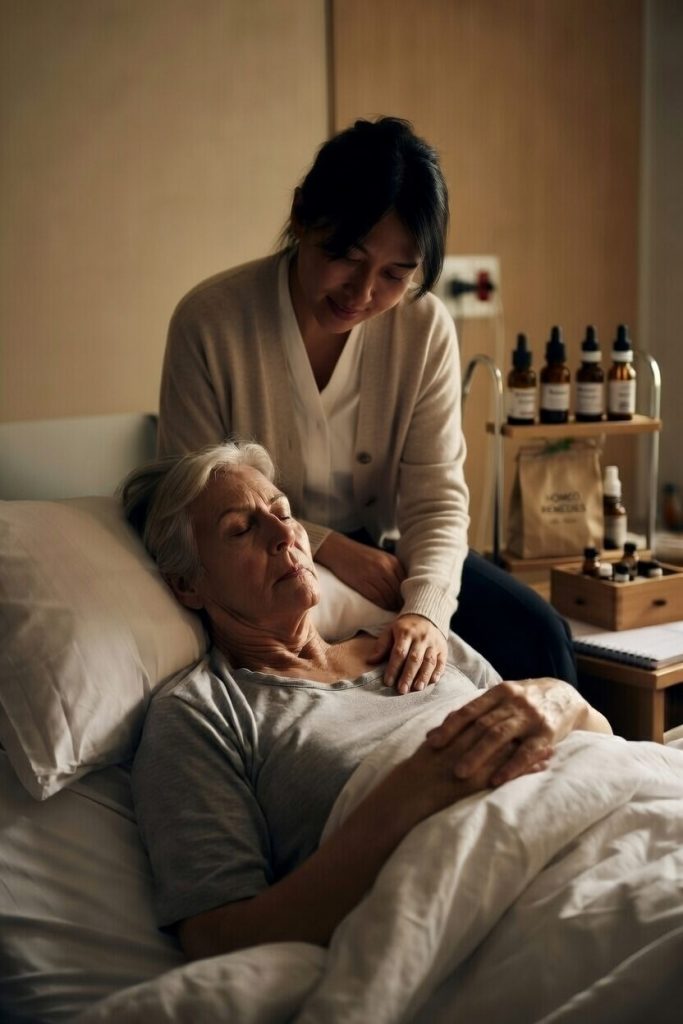
As life draws closer to its end, the priorities of care shift once more, from intervention to presence, from doing to being. In this final phase, the goals are simple yet profound: comfort, clarity, and peace.
Within hospice and home settings, homeopathy is often used to:
- Ease terminal agitation and restlessness
- Support deeper, more restorative sleep
- Reduce discomfort without heavy sedation
- Promote a sense of calm awareness
Families and caregivers sometimes observe subtle but meaningful changes, moments of lucidity, a more settled demeanor, or a gentler emotional transition. While these outcomes may not be easily measured, they resonate deeply with the essence of humane care.
Safety and Comfort
One of the practical advantages of homeopathy in palliative care is its safety profile. Due to the highly diluted nature of its remedies, adverse effects are rare. This is particularly important in patients who are already managing multiple medications and may be sensitive to additional pharmacological interventions.
The possibility of offering relief without increasing the burden of side effects is, in itself, a significant contribution. It allows for a gentler layer of support, one that can be integrated seamlessly into existing care plans.
The UK Perspective
The role of homeopathy within UK palliative care reflects both historical tradition and evolving integrative practices with a broader shift toward:
- Patient-centred care
- Non-invasive therapeutic options
- Integration of physical and emotional support
In community and hospice settings, homeopathy continues to be used by practitioners seeking to enhance comfort and individualise care, particularly where conventional approaches have reached their limits.
A Distinctive Contribution
Homeopathy’s contribution to palliative care is not competitive but complementary. It does not seek to replace conventional medicine, but to refine and enhance it, addressing the subtleties that often lie beyond the reach of standard treatments.
Its strengths include:
- Individualised symptom management
- Integration of emotional and physical care
- A gentle, well-tolerated approach
- Alignment with the core values of palliative medicine
Perhaps most importantly, it honours the uniqueness of each patient’s experience. In palliative care, where small improvements can carry profound significance, this attention to individuality becomes especially meaningful.
Final Thoughts
As the demand for palliative care continues to grow, particularly within ageing populations, there is an increasing need for approaches that prioritise quality of life without adding burden. Homeopathy offers a simple yet profound proposition: to listen deeply, respond gently, and support the whole person.
In the end, its value lies not only in how it helps manage symptoms, but in how it contributes to the experience of living, right to the very threshold of life itself.
Our reading room’s an opportunity to have personal time browsing our shelves full of wisdom.
The Helen Campbell Homeopathy Foundation SCIO is a registered educational charity focused on sharing homeopathy’s fascinating history and wonderful wisdom. We’re here to inform, not prescribe!