Introduction
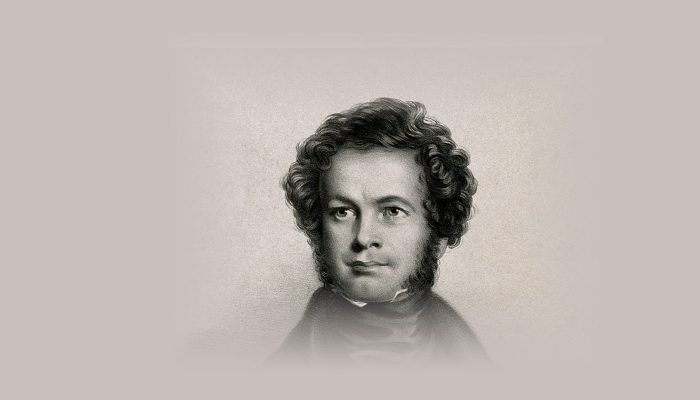
There are few figures in the history of medicine quite as remarkable as Samuel Hahnemann. Born in 1755 in the Saxon porcelain town of Meissen, he died at the age of 88 in Paris, beloved by the city’s social elite, wealthier than he could ever have imagined in his younger years, and married, scandalously, to a woman 45 years his junior. The arc of his life, from grinding poverty to Parisian triumph, takes in persecution, genius, controversy, extraordinary courage, and one of the most decisive intellectual leaps in the history of medicine.
He chose his own epitaph four years before he died: “Non inutilis vixi“, “I have not lived in vain“. It was a characteristic move: self-assured, a little defiant, and entirely accurate.
The Boy Who Taught Himself by Teaching Others
Christian Friedrich Samuel Hahnemann was born on 10 April 1755, the son of a porcelain painter. The family was modest, and money for education was not always available. Samuel was repeatedly pulled out of school for lack of funds. His response was to begin tutoring wealthier classmates in Greek and Latin, from the age of about twelve, to pay for his own schooling. His teacher, recognising something exceptional in the boy, eventually taught him free of charge.
By the time Hahnemann entered the University of Leipzig in 1775, he was fluent in at least eight languages including Latin, Greek, Hebrew, French, English, and Italian, with Arabic to follow. These languages were not merely an intellectual achievement they became his livelihood. Unable to afford his medical training through conventional means, he supported himself almost entirely through translation work, producing acclaimed German editions of English and French medical texts. This linguistic brilliance would, entirely by accident, trigger one of the most important experiments in medical history.
He graduated with honours from the University of Erlangen in 1779, married Johanna Küchler in 1782, and went on to have eleven children. It was an enormous family tofeed, and the financial pressure never entirely left him, until the final, extraordinary chapter in Paris.
The Man Who Gave Up Medicine On Principle
Something that is rarely emphasised when Hahnemann’s story is told is the fact that before he founded homeopathy, he gave up medicine entirely. Not for lack of talent or opportunity, but because he could no longer, in good conscience, practise it.
The medicine of the 1780s was brutal. Bloodletting, purging with toxic mercury compounds, emetics, opium prescribed in dangerous quantities, these were the tools of the trade. Hahnemann became convinced that he was causing more harm than good. He wrote later that “the thought of becoming in this way a murderer or malefactor towards the life of my fellow human beings was most terrible to me.” He walked away. For years, he and Johanna and their growing family lived in circumstances that can only be described as desperate. Historical accounts describe the family living in a single room divided by a curtain, with Hahnemann writing translations through the night to buy food. He worked every alternate night to find enough hours, and, to sustain himself, he took up smoking tobacco, a habit he kept until the very end of hislong life. The contrast with his final Paris years, where he died surrounded by wealth, receiving dukes and princesses in his consulting room, could scarcely be more dramatic.
The Experiment That Changed Everything
In 1790, Hahnemann was translating William Cullen’s Materia Medica from English into German. Cullen claimed that cinchona bark (the source of quinine) cured malaria because of its bitter, astringent properties. Hahnemann was sceptical. Other bitter, astringent substances didn’t cure malaria. So he did something radical: he took repeated doses of cinchona bark himself, over several weeks, to see what would happen. What happened was striking. He developed cold extremities, trembling, joint pain, fever, and anxiety, in other words, the symptoms of malaria itself. A substance that cured malaria in a sick person, taken by a healthy person, produced malaria-like symptoms. He had stumbled upon what would become the founding principle of homeopathy: similia similibus curentur (let likes be cured by likes).
It is worth noting, as a curious biographical detail, that Hahnemann had himself contracted malaria during his earlier years in Transylvania, which may have given him an unusual sensitivity to quinine during the experiment. Whether this influenced his symptoms or his interpretation of them remains one of medicine’s intriguing open questions. He spent the following six years testing this principle systematically, on himself, his family, and volunteers before publishing the formal statement of the ‘Law of Similars‘ in 1796 in Hufeland’s Journal. The word ‘homeopathy’ itself, from the Greek homoios (similar) and pathos (suffering) didn’t appear until 1807.
The Proving Method and Why Chess Was Banned
Hahnemann’s experimental method, which he called Prüfungen (provings), was unlike anything in medicine before it. Healthy volunteers took repeated doses of a single substance and kept detailed diaries of every physical, mental, and emotional symptom that arose. Their combined experiences built a composite ‘drug picture’ that would indicate what diseases that substance could cure. The methodology came with an elaborate list of restrictions. Volunteers were required to abstain from coffee, tea, alcohol, spices, and wine. This much is known. What is less often mentioned is that chess was also specifically prohibited, Hahnemann considered it “too exciting” and likely to contaminate the results. Beer, however, was apparently permitted. It is one of the more endearing inconsistencies in the history of experimental science. He proved 99 substances over his lifetime, recording the results in his landmark ‘Materia Medica Pura’, the founding document of homeopathic pharmacy that is still referenced today. The systematic testing of drugs on healthy human subjects, whatever one makes of the theoretical conclusions Hahnemann drew, was genuinely novel and is sometimes cited as a precursor to modern experimental pharmacology.
Persecution, Prosecution, and a Princely Rescue
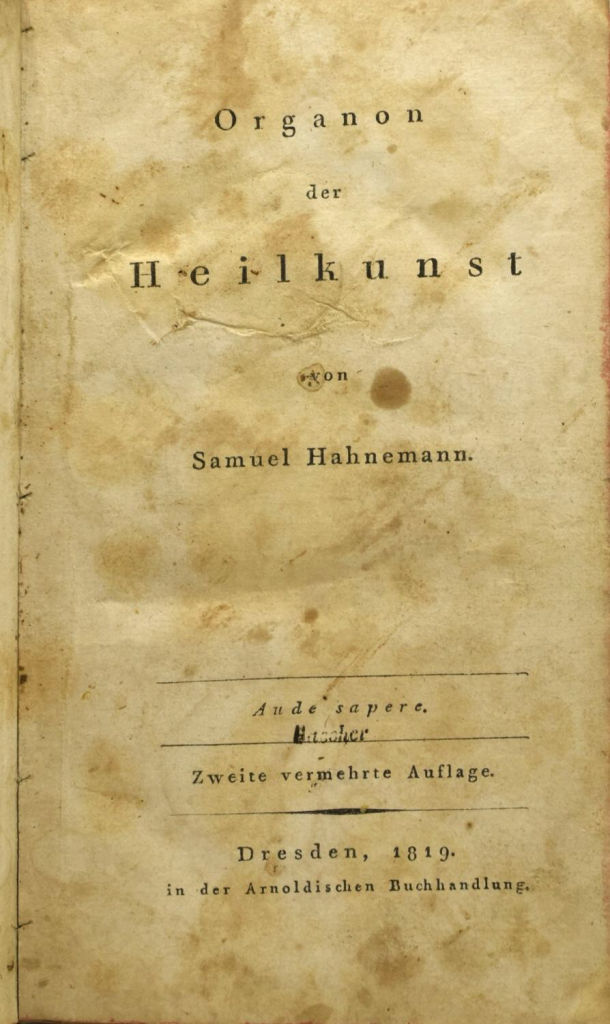
Hahnemann’s homeopathic practice brought him into immediate and prolonged conflict with the apothecaries of Germany. The apothecary guilds held a legal monopoly on the preparation and dispensing of medicines. Hahnemann, who didn’t trust apothecaries to make his precisely calibrated preparations correctly, insisted on preparing and dispensing his own remedies, and he charged next to nothing for them. This was both a legal violation and a financial catastrophe for the apothecary trade. The pattern repeated itself across more than a dozen German towns and cities. He would establish a practice, the apothecaries would bring legal action, and he would be forced to move on. In Leipzig, in 1820, he was formally convicted of illegally compounding medicines. Thirteen physicians published a joint newspaper attack on his methods. The hostility became so intense that leaving was the only option. Salvation came from an unlikely source. Duke Ferdinand of Anhalt-Köthen, ruler of a small independent German principality, was a devoted supporter of homeopathy and personally invited Hahnemann to settle there, granting him a special decree to practise and dispense his own medicines. It was, in effect, royal protection from the medical establishment. Hahnemann lived in Köthen from 1821 to 1835, the longest period of stability in his working life. All his great mature works, the later editions of the Organon, the Materia Medica Pura, the Chronic Diseases, were completed there.
Mélanie: The Most Surprising Chapter
In October 1834, a young French woman arrived at Hahnemann’s door in Köthen. Marie Mélanie d’Hervilly was 34 years old, a portrait painter who had survived a difficult childhood and was deeply interested in homeopathy. She had made the journey from Paris, over 900 kilometres, reportedly disguised in men’s clothing, as women were not permitted to travel alone. She came ostensibly as a patient. Within three days, Hahnemann, who was 79, had proposed marriage. They wed secretly in January 1835, just three months after meeting. The age gap was 45 years.
His adult children were predictably appalled. Historical accounts describe repeated attempts to keep the couple apart. Hahnemann’s response was characteristically decisive: he transferred a substantial portion of his existing wealth to his children and grandchildren in trust, then left for Paris with Mélanie. The message was clear. Everything earned thereafter would be hers. Mélanie was far more than a devoted young wife. She became one of the first female homeopathic physicians, practising alongside Hahnemann in Paris, writing prescriptions under his authority, and after his death continuing to treat patients until she was formally prosecuted in 1847 and acquitted. She eventually obtained a French medical licence in 1872. She was also, less admirably, the person who kept Hahnemann’s final manuscript, the sixth and definitive edition of the Organon, completed in 1842, locked away after his death in 1843. It was not published until 1921, 78 years later, when the American homeopathic community purchased it from her estate.
Paris and a Triumph No One Expected
Hahnemann and Mélanie arrived in Paris in June 1835. The city received them with an enthusiasm that must have seemed almost unreal to a man who had spent decades being prosecuted, expelled, and vilified.
The Parisian social elite filled his waiting room. Dukes, princesses, politicians, and intellectuals sat alongside ordinary patients, Hahnemann had always treated the poor for reduced fees or nothing at all, and he continued to do so in Paris. By the time of his death he had accumulated an estimated four million francs in wealth. The man who had once fed eleven children from a curtained single room had become one of the wealthiest physicians in Europe. He continued working harder than most people half his age. He completed the sixth and final edition of the Organon in 1842, aged 87. He died peacefully on 2 July 1843, of bronchial pneumonia, aged 88.
His burial was handled by Mélanie in characteristically private fashion: she obtained permission to delay burial for twenty days, then kept the time and location of the funeral secret, so that virtually none of his friends or followers could attend. He was initially buried in a modest family plot. Decades later, the remains were threatened with disinterment when maintenance fees fell into arrears. The worldwide homeopathic community campaigned to save them. In 1898, Hahnemann and Mélanie were exhumed and moved to Père Lachaise Cemetery in Paris, where they now rest among Chopin, Oscar Wilde, Édith Piaf, and Jim Morrison.
The Man in Washington
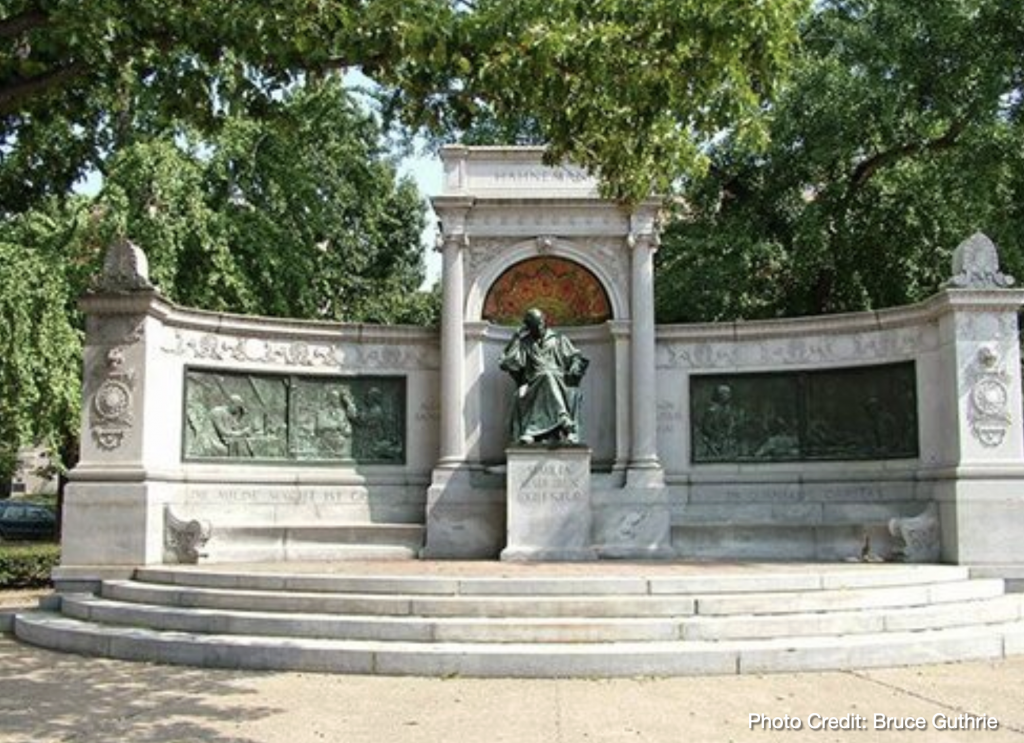
In the United States, Hahnemann has a peculiar distinction. The Samuel Hahnemann Monument at Scott Circle in Washington D.C., dedicated on 21 June 1900, makes him the only non-American foreigner without a Revolutionary War connection to have a monument in the American capital. The dedication was attended by President William McKinley, accompanied by the Marine Corps Band. The monument cost around $75,000, funded almost entirely by the American Institute of Homeopathy over nearly two decades of public fundraising. The inscription at the base reads: “Non inutilis vixi.” I have not lived in vain. The words he chose for himself in 1839, four years before he died.
By 1900, the United States alone had 22 homeopathic medical schools, 111 homeopathichospitals, and 15,000 practising homeopathic physicians. The system founded by a Meissen porcelain painter’s son had become a global phenomenon. Multiple sources, including the World Health Organization (WHO), recognise homeopathy as the second largest system of medicine in the world. It is used by over 200 million people globally, with some estimates reaching up to 450 million users annually.
Final Thoughts
Samuel Hahnemann was argumentative, secretive, extraordinarily hard-working, and capable, by several accounts, of volcanic outbursts when challenged. He was also a man of genuine moral courage who gave up a safe career on principle, rebuilt himself from nothing, endured decades of professional persecution without abandoning his convictions, and found, at 79, a love that transformed the final chapter of his life entirely. Whatever one’s view of homeopathy’s mechanisms, the life of the man who created it is one of the most unusual, dramatic, and genuinely moving stories in the history of medicine. He dared to be wise and he was not wrong to think it had not been in vain.
Our reading room’s an opportunity to have personal time browsing our shelves full of wisdom.
The Helen Campbell Homeopathy Foundation SCIO is a registered educational charity focused on sharing homeopathy’s fascinating history and wonderful wisdom. We’re here to inform, not prescribe!