Introduction
Britain’s relationship with travel sickness is longer and more intimate than most nations can claim. An island people who built an empire on seafaring, who cross the Channel for their holidays, who commute on winding rural roads and aging railway stock, the British have been getting sick in transit for centuries. And for almost two of those centuries, they have been reaching for homeopathic remedies to manage it.
The history of homeopathic travel medicine in Britain is surprisingly rich, rooted in the maritime culture of the Victorian era and persisting through to the modern Scottish health service. It is a story worth telling, not least because the remedies that worked on a packet steamer from Glasgow to Belfast in 1885 remain precisely the same remedies that work on the CalMac ferry from Oban to Mull today.
The Maritime Heritage: Liverpool, Glasgow, and the Medicine Chest
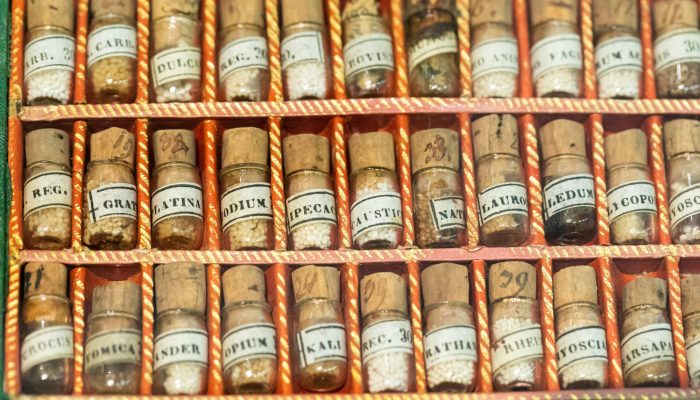
The great homeopathic pharmacies of 19th-century Britain were concentrated in the port cities, and this was no coincidence. Thompson & Capper, the renowned homeopathic chemists of Liverpool and Birkenhead, produced elegant wooden medicine chests designed specifically for sea voyages. Several survive in the Science Museum collection in London, dated 1880–1920, their compartments still labelled with remedy names in copperplate script. These were not curiosities for the wealthy. They were standard equipment for officers, merchants, and emigrant families embarking on long passages from Liverpool to New York, Cape Town, or Melbourne.
Glasgow, Britain’s second city of empire and the Clyde’s shipbuilding capital, had its own thriving homeopathic culture. The Glasgow Homoeopathic Hospital, established in 1880, served a city whose population lived and worked around maritime trade. Dock workers, merchant seamen, and the families who waved them off from the Broomielaw all had reason to understand travel sickness intimately. The hospital’s dispensary would have supplied remedies to passengers and crew heading down the Clyde and out into the Atlantic.
It is a curious and largely forgotten fact that homeopathy’s strongest institutional presence in Scotland was rooted in a city defined by its ships.
Scotland’s Unique Relationship with Motion
Scotland presents particular challenges for the motion-sensitive. Consider the geography: over 900 islands, connected by ferry services that cross some of the most exposed waters in Europe. The Minch, the Pentland Firth, the Sound of Mull in a south-westerly gale, these are crossings where even experienced sailors feel their stomachs rise. CalMac alone carries over five million passengers annually across routes where sea conditions can shift from millpond to brutal within minutes.
Then there are the roads. Anyone who has driven the A82 along Loch Lomond, the single-track roads of the Highlands, or the endless switchbacks of the Applecross peninsula knows what car sickness means in Scotland. These are not motorway journeys. They are winding, climbing, descending, lurching experiences that challenge the vestibular system in ways that a straight run down the M1 never could.
And, of course, there is the weather. Scotland’s low atmospheric pressure systems and persistent wind mean that ferry crossings are more likely to be rough, roads more likely to be buffeted, and passengers more likely to arrive at their destination wishing they had packed something useful in their bag.
Statistics bear this out at a national level. Across Britain, approximately 46–59% of people report experiencing car sickness at some point. For sea travel, 25–30% are affected even in calm conditions, rising to 60% in moderate seas. On exposed Scottish crossings in winter, the figure would be higher still. Motion sickness is not a niche concern for the Scottish traveller. It is a routine consideration.

Cocculus on the Caledonian Sleeper
Cocculus indicus remains the most broadly indicated remedy for motion sickness, and its particular affinity for cases worsened by sleep deprivation makes it especially relevant to certain British travel experiences. The overnight ferry from Aberdeen to Shetland. The Caledonian Sleeper from London to Fort William, where the combination of motion and broken sleep leaves passengers arriving with the hollow, weak, nauseous emptiness that Cocculus describes so precisely.
The proving picture is clear: vertigo and nausea with a profound empty sensation in the stomach. The thought or smell of food is revolting. Watching movement passing scenery, waves, other vehicles, intensifies everything. The patient wants to lie still with their eyes closed. And crucially, sleep loss makes the entire picture worse.
A study of 30 patients treated with individualised homeopathic remedies for motion sickness found that 27 out of 30, ninety percent, reported significant relief or full recovery, with Cocculus among the most frequently indicated remedies. For the traveller who knows they will be facing both motion and disrupted sleep, it is the natural first consideration.
Tabacum: The White-Faced Ferry Passenger
The crossing from Ardrossan on the west coast mainland, to Brodick on the island of Arran on a rough day. The ferry from Ullapool to Stornoway when the Minch is running high. The short but savage hop from Gill’s Bay to St Margaret’s Hope across the Pentland Firth. These are the journeys where Tabacum comes into its own.
The Tabacum picture is dramatic and unmistakable: the passenger is deathly pale, bathed in cold sweat, with a terrible sinking sensation in the pit of the stomach. The nausea is continuous and violent. They are desperate for cold, fresh air, they will be found on deck regardless of the weather, because the enclosed saloon with its smell of engine diesel and other passengers’ breakfasts is unbearable. They look, frankly, as though they might die. They may feel that way too.
This is severe seasickness, the kind that reduces strong adults to helpless misery. In conditions where 60–90% of passengers are affected, Tabacum addresses the most extreme presentation. The keynote differentiator from Cocculus is the deathly pallor combined with cold sweat. The Cocculus patient is weak and hollow. The Tabacum patient looks like they have lost all their blood.
Petroleum: The Snacker’s Remedy
Here is a curious remedy with a keynote so distinctive it makes prescribing almost effortless. Petroleum is indicated when motion sickness is, paradoxically, improved by eating. While most sufferers cannot bear the thought of food, the Petroleum patient instinctively reaches for dry crackers, bread, or plain biscuits and finds genuine relief.
This is relevant for the practical reality of Scottish travel. Long ferry crossings with basic cafeterias. Winding Highland roads with limited opportunities to stop. The parent who discovers that giving the child a plain oatcake in the back seat actually prevents the nausea from escalating. If eating helps, Petroleum is almost certainly the remedy, regardless of the transport type.
There is also an affinity with occipital headache (pain at the base of the skull) and excessive salivation, and a general improvement from warmth. The patient who wraps up warm, eats small amounts, and feels better for both is presenting a classic Petroleum picture.
Borax: The Remedy for Turbulence and Scottish Roads
Borax occupies a unique position in the travel sickness materia medica because it addresses something no other remedy, and no conventional treatment, specifically targets: sickness triggered by downward motion.
This is not about sustained rocking or continuous forward movement. It is about the stomach-lurching sensation of descent. The aircraft hitting an air pocket on approach to Edinburgh or Inverness. The car cresting a hill on the A9 and dropping suddenly on the other side. The ferry lifting on a wave and then falling into the trough.
The original proving described infants who screamed when being laid down or rocked downward, a falling reflex triggering distress and nausea. In adults, it manifests as a specific fear and sickness response to that dropping sensation. For the traveller whose problem is not the journey itself but the bumps, drops, and air pockets within it, Borax is remarkably specific.
Anyone who has driven the A87 to Skye, with its endless rises and sudden descents, or flown into Barra on a windy day. landing on the beach with the plane dropping and lifting unpredictably, will recognise the Borax trigger instantly.
Nux Vomica: The Monday Morning Commuter
Not all travel sickness happens on ferries and aircraft. For many people in Britain, it happens on the daily commute, the stop-start bus journey into Glasgow or Edinburgh, the winding country road to work, the overheated train carriage with its swaying motion and strange smells.
Nux vomica suits a very particular commuter: the one who is already irritable, overstimulated, and running on too much coffee. The nausea comes with a splitting headache, typically at the back of the head or concentrated over one eye. There is an oversensitivity to everything: noise, smells, light, conversation. The window must be open. Anyone who speaks to them will be snapped at.
This is the constitutional Nux vomica picture, the overworked, wound-tight individual whose nervous system is already at capacity before the motion begins. The journey is simply the final straw. It is particularly relevant for car sickness in stop-start urban traffic, where the unpredictable acceleration and braking pattern adds insult to an already overstimulated system.

Building Your Scottish Travel Kit
For the traveller in Scotland, facing ferries, Highland roads, island-hopping flights, and winter weather, a compact remedy kit covering the main presentations offers remarkable flexibility:
Cocculus for general motion sickness, especially with sleep deprivation, the overnight ferry, the early start after a broken night. Tabacum for severe seasickness with pallor and cold sweat, the rough Minch crossing, the winter Pentland Firth. Petroleum for the traveller who improves with eating the long CalMac crossing where a plain roll from the cafeteria makes all the difference. Borax for a sickness triggered by drops and descents, the turbulent flight into Kirkwall, the roller-coaster A-roads of the West Highlands. Nux vomica for the irritable, overstimulated commuter whose journey is one insult too many.
Five remedies. Five clearly differentiated pictures. Between them, they cover the vast majority of motion sickness presentations that Scottish geography can produce, and Scottish geography, it must be said, produces more variety of motion challenge per square mile than almost anywhere in Europe.
Final Thoughts
The medicine chests that sailed from the Clyde in the 1880s contained the same remedies that a traveller would pack today. Cocculus, Tabacum, Petroleum, Nux vomica, these are not new discoveries. They are established, well-proved remedies with over two hundred years of clinical application behind them. The seas have not changed. The winding roads remain. The human vestibular system is as delicate and as individual as it ever was.
What homeopathy offers the travel-sick patient is not merely symptom suppression but genuine differentiation, the recognition that one person’s motion sickness is not another’s, and that the remedy which matches the individual’s specific experience works in a way that a blanket prescription never can. For a nation of island-hoppers, ferry-catchers, and Highland road drivers, that precision remains as practical and as relevant as it was when the first medicine chest was packed for a voyage down the Clyde.
Our reading room’s an opportunity to have personal time browsing our shelves full of wisdom.
The Helen Campbell Homeopathy Foundation SCIO is a registered educational charity focused on sharing homeopathy’s fascinating history and wonderful wisdom. We’re here to inform, not prescribe!