Introduction
As the gardening year moves from winter dormancy into active growth, the seasoned gardener recognises this as a period of heightened sensitivity. Sap rises, soils warm unevenly, and weather patterns remain erratic. For practitioners familiar with the principles of homeopathy, this transitional season is not merely a technical challenge but a moment when constitutional imbalances in plants, soil, and environment become especially visible.
Homeopathy for gardeners has matured well beyond novelty. Across the UK, and particularly in climatically demanding regions, it is increasingly applied as a responsive, observation-led approach to plant vitality. At this time of year, late winter into spring, the method finds some of its clearest expressions.
Seasonal Stress in the Garden: A Statistical Snapshot
Spring is consistently the most damaging season for UK gardens. According to long-term horticultural surveys, approximately 65–70% of plant losses occur between March and May, largely due to fluctuating temperatures, late frosts, waterlogging, and transplant shock. The Royal Horticultural Society has also noted that last frost dates now vary by as much as three weeks year-on-year, increasing uncertainty for even experienced gardeners.
Coastal and exposed gardens face additional pressures. Salt spray can affect plants up to 10 miles inland, and wind desiccation increases transpiration before roots are fully active. These are not abstract stresses; they manifest as leaf scorch, growth stagnation, and sudden collapse, classic pictures familiar to homeopathic observation.
Reading the Garden Homeopathically
For the informed lay homeopath, applying remedies to plants is not a matter of treating ‘disease’ but of recognising patterns of disturbance. The garden, viewed homeopathically, is an ecosystem expressing symptoms.
Early spring symptoms commonly include:
- Sudden wilting despite adequate moisture
- Leaf burn following cold, bright days
- Stalled growth after transplanting
- Poor flowering following winter damage
- Shock responses after frost or hail
These expressions parallel well-known remedy pictures. At this time of year, remedies associated with shock, exposure, mineral imbalance, and environmental stress tend to come to the fore.
Remedies in Seasonal Focus
Natrum muriaticum: Widely recognised for its relationship to salt, Natrum muriaticum is particularly relevant in early spring. Beyond obvious coastal exposure, salt stress may arise from winter road runoff, concentrated soils after dry spells, or mineral imbalance revealed by thaw.
In plants, the Natrum muriaticum picture often includes:
- Leaf edge burn or dryness
- Sensitivity to sun following cold
- Poor recovery after winter stress
- General withdrawal or stagnation
Its usefulness at this time of year reflects the plant’s attempt to regulate water and mineral balance as growth recommences.
Aconite: Aconite remains one of the most frequently used remedies in spring gardening, reflecting the prevalence of sudden shocks. Late frosts, icy winds, or abrupt temperature drops commonly produce an Aconite picture: rapid collapse, blackened tissue, and a “frozen” appearance in growth.
Applied promptly after a shock event, Aconite is often followed by a constitutional or situational remedy once the acute phase has passed.
Arnica and Ruta; For physical disturbance, digging, division, pruning, or mechanical damage, Arnica and Ruta continue to play a role. Early spring is when gardeners do the most structural work, and plants frequently show delayed stress responses weeks later.
Homeopathy in Gardening: Recent Developments in Scotland
One of the more detailed contemporary applications of garden homeopathy comes from Northeast Scotland, where climatic exposure and coastal conditions create an ideal testing ground for resilience-based approaches.
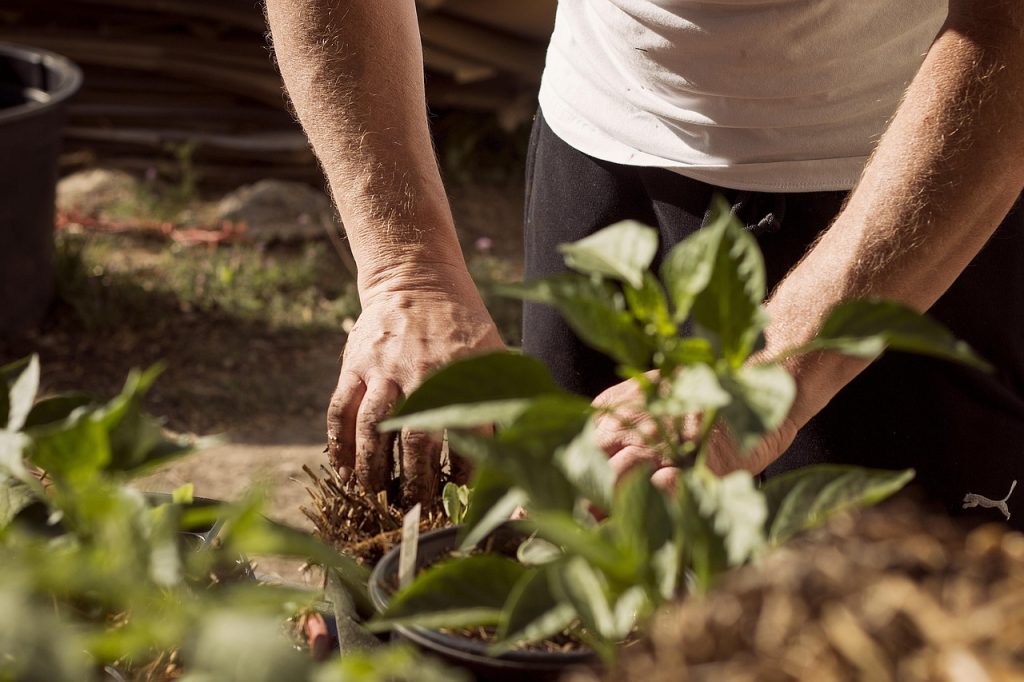
After relocating in 2022, gardener and homeopath Carolyn Foster-Richards encountered a coastal garden suffering from salt damage and extreme weather. Rather than undertaking wholesale replacement, a homeopathic strategy was applied during spring preparation.
In April 2023, Natrum muriaticum 30C was selected for its affinity with salt stress. Alongside this, Bach Flower Remedies (Rescue Remedy and Walnut) were used to address transplant shock and the effects of environmental change. By July 2023, approximately 90% of plants had recovered, with productive yields including blueberries, strawberries, and blackberries.
A subsequent frost event in May 2023 prompted the use of Aconite 30C for acute shock, followed again by Natrum muriaticum. Privet hedging responded with strong regrowth by midsummer.
From July 2023, electroculture techniques were also introduced, using copper-wrapped bamboo canes to enhance plant resilience. While distinct from homeopathy, this integration reflects a broader trend: gardeners applying subtle energy-based approaches in complementary ways.
This case study illustrates not only the adaptability of homeopathic principles but their relevance to real-world gardening under increasingly volatile conditions.
Electroculture and Homeopathy: Parallel Sensitivities
Electroculture is an umbrella term for a range of agricultural and gardening techniques that work with natural atmospheric, telluric (earth-based), and electromagnetic energies to influence plant growth, vitality, and resilience. Rather than adding substances to the soil, electroculture aims to modulate the energetic environment in which plants develop. Although electroculture sits outside classical homeopathy, its growing use among homeopathic gardeners is notable. Both approaches rely on sensitivity rather than force, working with environmental signals rather than overriding them.
Early spring appears to be a particularly responsive window for such techniques. Plants emerging from dormancy show heightened receptivity, and gardeners report improved establishment, reduced pest pressure, and more even growth patterns when subtle interventions are introduced before stress accumulates.
Pests, Predators, and Balance
Spring pests are another area where homeopathic thinking becomes relevant. Slugs, aphids, and flea beetles typically surge as temperatures rise. Statistically, slug damage alone accounts for up to 40% of seedling losses in UK vegetable gardens each year.
Rather than targeting the pest directly, the homeopathic gardener observes susceptibility. Why are certain plants repeatedly affected while others remain untouched? Remedies are often selected based on the plant’s response, soft, watery growth suggesting one picture; brittle, stressed tissue another.
This approach reframes pest pressure as information rather than invasion.g and contextual sensitivity.
Potencies, Timing, and Application
For gardeners already conversant with homeopathic practice, questions of potency and repetition remain central.
- 30C remains a common choice for acute seasonal stress
- Applications are often timed to environmental events rather than calendars
- Over-application is generally avoided; observation guides repetition
Spring rewards restraint. Plants change rapidly at this time of year, and remedy responses may be visible within days rather than weeks.
The Garden as a Responsive System
What distinguishes homeopathy for gardeners at this season is not the individual remedy but the mindset. The garden is approached as a living, responsive system rather than a collection of problems to be solved.
As climate variability increases, recorded UK spring rainfall has risen by over 20% since the 1980s, while late frost events remain stubbornly persistent, the value of adaptable, observation-based methods becomes clearer.
Homeopathy offers a language for reading stress, recovery, and resilience. For the well-informed gardener, spring is not simply a race to plant but an invitation to listen.
Final Thoughts
At this time of year, when growth surges ahead of stability, homeopathy finds one of its most natural homes in the garden. The principles familiar from human and animal practice translate readily to plants navigating shock, exposure, and transition.
From coastal Scotland to sheltered allotments, gardeners are refining these applications not as ideology but as practice, responding to what is seen, season by season. In doing so, the spring garden becomes not just productive, but articulate.
Our reading room’s an opportunity to have personal time browsing our shelves full of wisdom.
The Helen Campbell Homeopathy Foundation SCIO is a registered educational charity focused on sharing homeopathy’s fascinating history and wonderful wisdom. We’re here to inform, not prescribe!