Introduction
In the summer of 1890, Vincent van Gogh arrived in the village of Auvers-sur-Oise, northwest of Paris. He was unwell, fragile, and looking for a doctor who might understand him. The doctor he found was Paul-Ferdinand Gachet.
Gachet was a physician who practised homeopathy. He was also a painter, a printmaker, and a collector. His home was filled with art. His consulting room was filled with remedies. He believed the mentally ill should be part of society, not locked away from it, and he advised Van Gogh to “work a great deal, boldly.”
Over the next ten weeks, Van Gogh painted furiously. Among the canvases from that period is the famous Portrait of Dr Gachet, one of the most recognisable paintings in the world. The man in the portrait was a homeopath.
Gachet didn’t just treat Van Gogh. He treated Renoir. Pissarro. Cezanne. It was Pissarro who recommended Gachet to Van Gogh’s brother Theo. The Impressionists trusted this homeopathic doctor because he saw them as whole people, not as collections of symptoms. His approach to medicine and his love of art were not separate things. They came from the same instinct: look closely, see what is really there, and respond to what you find.
The Metropolitan Museum of Art later held an exhibition documenting Gachet’s collection and his extraordinary relationships with some of the greatest artists in history. The exhibition was called “Cezanne to Van Gogh: The Collection of Doctor Gachet.” At its centre was a man who practised homeopathy.
What words can’t always reach
Homeopathic practice depends on understanding the individual. Not just the condition, but the person experiencing it. Two people with the same diagnosis may need entirely different remedies because their experience of the illness is different. Finding the right remedy means understanding how they feel, what makes it worse, what makes it better, what their emotional state is, what they’re afraid of. The consultation is a conversation, and it relies on the patient’s ability to put their inner world into words.
But not everyone can do that. Some experiences sit below language. Grief that hasn’t found a shape. Anxiety that has no clear cause. Exhaustion that goes deeper than tiredness. A child who can’t explain what’s wrong. An elderly person whose vocabulary for distress has narrowed to “I’m fine.”
This is where creative expression can reach what conversation alone sometimes can’t.
As the Helen Campbell Homeopathy Foundation SCIO notes, art can be used as an additional tool to explore the deeper psyche and understand what remedies are required. Not art as decoration, and not art as distraction. Art as a way of seeing the person more clearly.
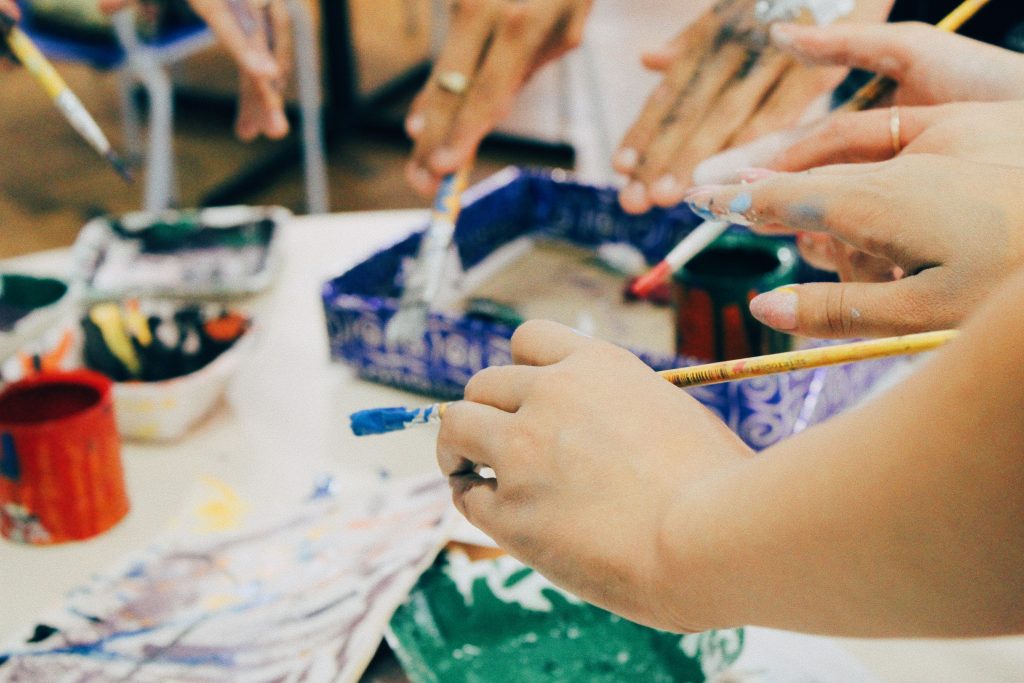
A drawing of how someone feels might reveal patterns, intensities, and spatial relationships they would never describe in words. A colour choice can carry emotion that verbal language flattens. A piece of clay shaped without thinking might express something the patient didn’t know they were holding. These are not diagnostic tests. They are openings. Ways in.
Hahnemann and the eye that sees
Samuel Hahnemann, the founder of homeopathy, understood this. In his essay “The Medical Observer,” written as an introduction to the Materia Medica Pura in 1825, he recommended three things to sharpen a practitioner’s faculties of observation: familiarity with Greek and Roman classics, knowledge of mathematics, and drawing.
“The art of drawing from nature is also useful,” he wrote, “as it sharpens and practices our eye, and thereby also our other senses, teaching us to form a true conception of objects, and to represent what we observe, truly and purely, without any addition from the fancy.”
Drawing. Not as a hobby or a relaxation technique. As a discipline for seeing. The act of drawing forces you to look at what is actually in front of you rather than what you assume is there. “Truly and purely, without any addition from the fancy.” That phrase could define the homeopathic consultation itself. These are the same skills a homeopath uses in consultation: observing the patient’s posture, their gestures, the way they hold themselves, the things they say without saying them.
Hahnemann knew that good prescribing starts with good observation. And he knew that artistic practice sharpens the kind of seeing that matters most in medicine: the seeing of what is really there, not what the textbook says should be.
Where circles overlap
There is a growing recognition in the UK that creative engagement and health are connected. The National Centre for Creative Health, formed in response to the All-Party Parliamentary Group on Arts, Health and Wellbeing, advocates for creative practice becoming integral to health and social care. The NHS social prescribing model now enables GPs to refer patients to community arts groups, choirs, gardening clubs, and other creative activities. An estimated 5,000 to 10,000 creative health practitioners work across the UK.
This movement shares more with homeopathy than either side might realise.
Both work with the whole person, not just the presenting symptom. Both value individual expression over standardised protocols. Both understand that symptoms communicate something about the person, and that suppressing the expression without understanding it misses the point. Both require the practitioner to be a skilled, attentive witness rather than an authority delivering instructions.
In Eastbourne, an organisation called Compass Community Arts has been working for many years with people vulnerable to isolation, trauma, severe and enduring mental illness, neurodivergence and hidden disabilities. Its Project Director, Fenya Sharkey, brings over thirty years of experience in social arts practice. Their approach is built on a simple belief: people feel most empowered when they are given independence, responsibility and the opportunity to be at the giving end of care.
There is a clear philosophical resonance here with the idea that healing or change cannot simply be imposed from outside. Compass makes no claim about homeopathy, and its work arises from community arts practice rather than a medical model. But both approaches place value on attentiveness to the individual and on resisting the tendency to reduce a person to a category or diagnosis.
Writing in Perspectives, the international journal for anthroposophic social development published by the Goetheanum, Fenya explored how inclusive community work begins not with a programme but with a question: how can people of all abilities participate?
That starting point, a question rather than an answer, is significant. It means that the practitioner does not begin by deciding in advance what the person needs to become, but by paying attention to what becomes possible when the conditions of participation change.
“Creative expression can reveal something that conversation alone may miss because it changes the relationship between people. We are no longer asking somebody to explain themselves, describe what is wrong, or fit their experience into language that has already been given to them. When people are making something, they choose, respond, refuse, alter, imagine and contribute. We begin to encounter the person through what they do rather than through the categories that have been applied to them.
At Compass, we are less interested in interpreting what somebody makes than in paying attention to what becomes possible through the making. Sometimes what emerges is an emotion that could not easily be spoken, but just as often it is agency, humour, curiosity, competence or a capacity for relationship that had become invisible within a medical or service-based description of the person. Creative practice does not simply give us another way of looking at somebody. It can create the conditions in which they are able to show us who they are.”
[Fenya Sharkey, Project Director, Compass Community Arts]
Compass’ creative practice is deliberately non-prescriptive. Rather than beginning with a curriculum, treatment goal or predetermined outcome, facilitators pay attention to what people bring and allow the activity, relationships and possibilities to develop from there.
The important question is not “what intervention does this person need?” but “what becomes possible when this person has genuine authorship, responsibility and the opportunity to contribute?”
In the language of this article, there is a parallel here with individualisation, although Compass arrives there through community arts practice rather than homeopathy.
There is also an important distinction. Creative expression does not merely reveal a fixed, hidden self waiting to be discovered. The conditions of the encounter matter. A person who has been known primarily as a patient, service user, disabled person or recipient of care may appear very differently when they are given authorship, responsibility and the possibility of affecting what happens next.
What emerges is therefore not simply better information about the person. New capacities, relationships and forms of participation can become visible because the social conditions have changed.
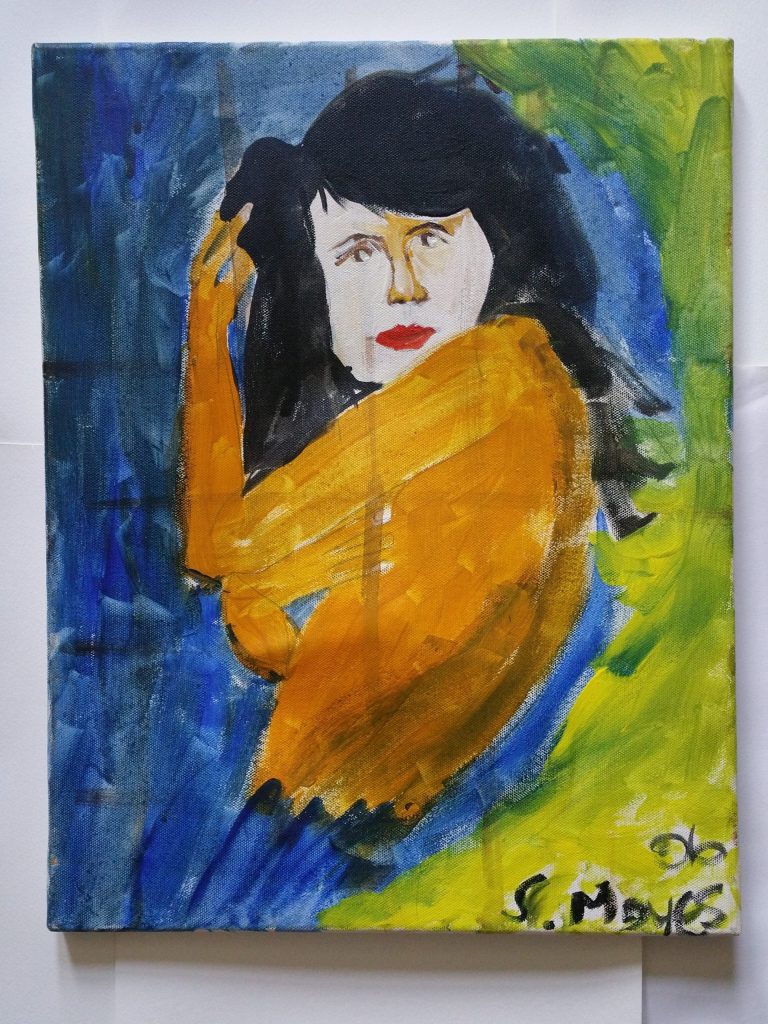
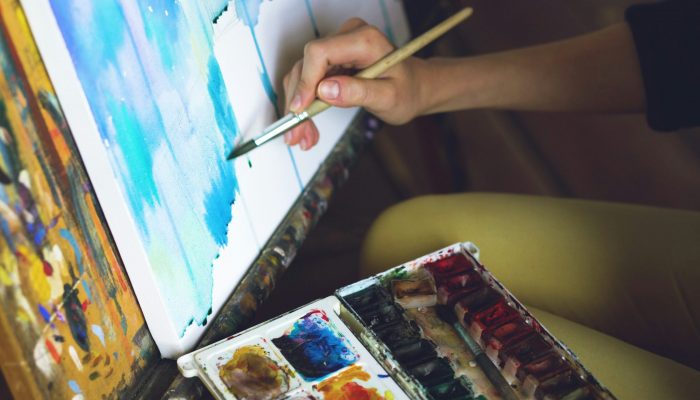
Painting by Sheena Moyes
The conversation that art opens
What connects Gachet’s consulting room in 1890 to a community arts workshop in Eastbourne today is not technique. It is attention.
The homeopath listens to the patient’s story and watches for the thread that leads to the remedy. The arts facilitator watches for the moment when creative activity opens another form of encounter. Neither begin by imposing an interpretation. Both depend upon paying attention.
But creative practice can also do something more than make the existing person easier to see. It can alter the conditions in which a person is encountered. Someone who struggles to describe themselves in the language of services may show agency, humour, imagination, competence or relational capacity when the encounter is no longer organised around what is wrong with them.
In a healthcare system that runs on ten-minute appointments and standardised pathways, this kind of attention is increasingly rare. Both homeopathy and creative arts practice insist on the importance of the individual. Both resist the idea that the person in front of us can be fully understood through diagnosis alone.
Art does not replace the homeopathic consultation, nor should creative work be treated as a diagnostic test. But it can open another form of communication and another kind of relationship. For people who struggle with spoken language, or whose experience has been repeatedly interpreted through medical or service categories, making something can create a different place from which to meet.
And it reminds practitioners of something Hahnemann knew over two hundred years ago: that seeing clearly requires discipline, attention and a willingness to notice what is actually there rather than what we expect to find.
Final thoughts
Gachet saw something in his artist patients that went beyond their medical complaints. He saw their creativity as inseparable from their humanity, and he responded to both. That instinct, to see the whole person and to use every available means to understand them, is as alive today as it was in the consulting rooms and studios of nineteenth-century France.
But perhaps creative practice suggests something further. Seeing the whole person is not only a matter of looking more carefully. Sometimes we have to change the conditions of the encounter before aspects of a person can become visible at all.
The tools have changed. The principle hasn’t. Whether through a conversation, a painting, or a piece of clay, the task is not simply to interpret what appears, but to pay sufficient attention to recognise the person, the possibilities they bring, and what may emerge when they are given the space to participate.
Our reading room’s an opportunity to have personal time browsing our shelves full of wisdom.
The Helen Campbell Homeopathy Foundation SCIO is a registered educational charity focused on sharing homeopathy’s fascinating history and wonderful wisdom. We’re here to inform, not prescribe!