You may know the kind of flu that comes as a weight rather than a fever. Your arms and legs feel like they’ve got lead in them. The eyelids won’t stay up. A shiver runs up the back and won’t settle. You aren’t thirsty, and you don’t want anyone fussing.
Or you may know the other version, with no illness at all. The morning of a driving test. The speech at a family wedding. The knees go, the hands shake, and you’d give anything to be left in peace.
Homeopaths see one remedy picture in both: Gelsemium.
A beautiful, poisonous climber
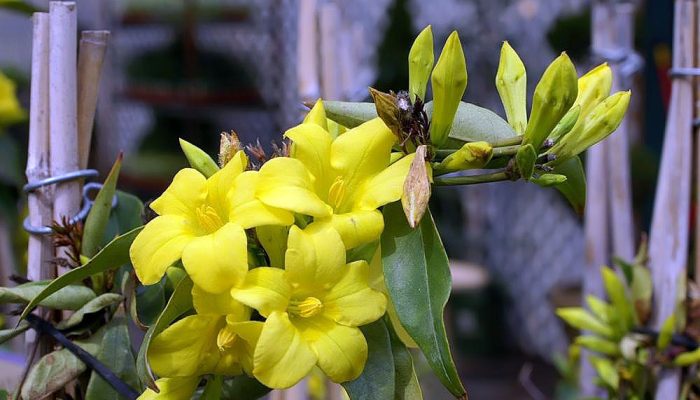
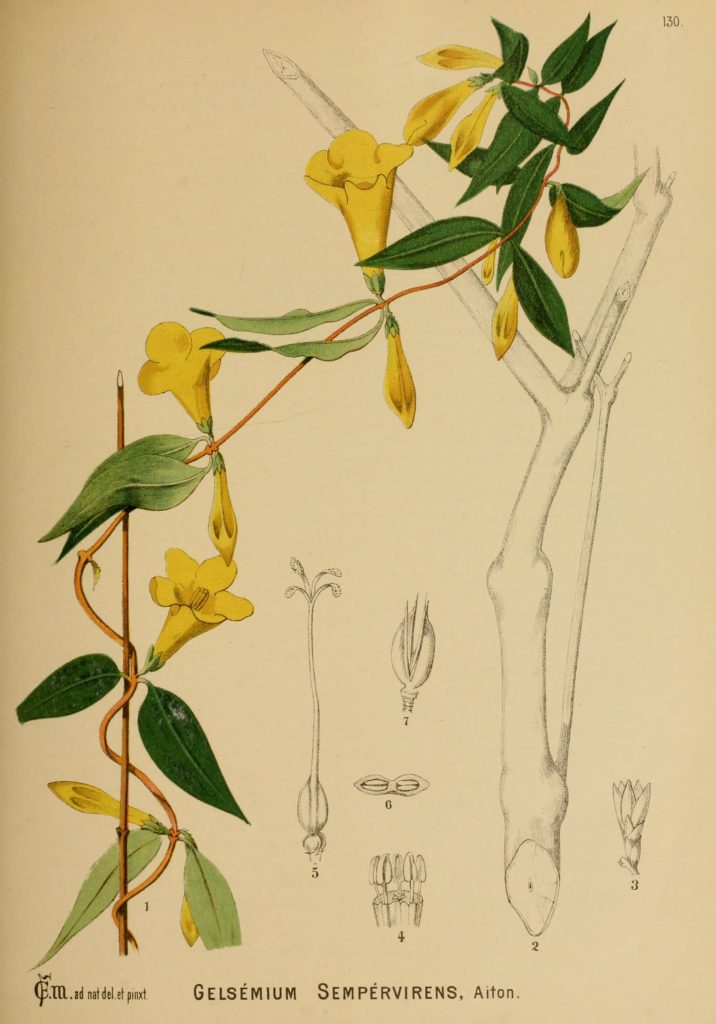
Gelsemium sempervirens is an evergreen climbing plant of the south-eastern United States, with scented yellow trumpet flowers in early spring. It goes by yellow jessamine or Carolina jasmine, though it isn’t a true jasmine; its name comes from the Italian word for jasmine. It’s South Carolina’s state flower.
It’s also poisonous in every part. Children have been poisoned by sucking the nectar, mistaking the flowers for honeysuckle.
A mistake with a root
The plant’s way into medicine is told as an accident. In the first edition of King’s American Eclectic Dispensatory (1852), a Southern planter is ill with fever. His servant digs up the wrong root and gives him a brew of gelsemium instead of the garden plant intended. The man loses all power in his limbs and seems close to death. Then he recovers, and the fever is gone. A physician went on to sell a gelsemium medicine as the “Electrical Febrifuge”. The story may well have grown in the telling, but it was repeated for decades.
Homeopaths took a more careful route. In 1862 the American homeopath Edwin Hale published a monograph on the plant, drawing on provings in some seventy people and on himself. The weakness and trembling that frightened the planter’s household became the heart of the remedy picture.
The Gelsemium picture
William Boericke’s materia medica opens its Gelsemium entry with four words that sum it up: “Dizziness, drowsiness, dullness, and trembling.”
The Gelsemium person is heavy and slow. The eyelids droop; Boericke says the patient “can hardly open them”. Chills creep up the spine. The legs feel too weak to trust. And, unusually for someone feverish, they don’t want a drink: “As a rule, the Gelsemium patient has no thirst.”
Above all, they want stillness. “Desire to be quiet, to be left alone.” Yet when the trembling takes hold, Boericke also notes the person who “wants to be held, because he shakes so”.
The same entry lists both “Influenza” and “Stage fright”. That’s the double life of this remedy. The person in bed with flu who doesn’t want the radio on, a cup of tea or a visitor. The person outside the exam hall who isn’t pacing, but sitting very still, going weak at the knees.

Heavy, or hurried?
Next time nerves arrive before a big day, notice which way you go. Gelsemium slows down, goes heavy and wants to be left alone. Its opposite in the materia medica, Argentum nitricum, speeds up, rushes and can’t stop moving. You’ll find the two side by side in Exam Stress Through a Homeopath’s Eyes.
Gelsemium is for when everything grows heavy. For life’s knocks and tumbles, there’s Arnica.
Image credits: yellow jessamine photo by David J. Stang, CC BY-SA 4.0.
Our reading room’s an opportunity to have personal time browsing our shelves full of wisdom.
The Helen Campbell Homeopathy Foundation SCIO is a registered educational charity focused on sharing homeopathy’s fascinating history and wonderful wisdom. We’re here to inform, not prescribe!
Written with AI assistance and checked by our team.