Introduction
The idea that colour heals is not new. It is older than homeopathy, older than Western medicine, older than most things we think of as modern.
Egyptian papyri from 1500 BC list colour cures. Their temples were designed so that sunlight passed through coloured crystals, casting specific colours onto patients. The god Thoth was credited with discovering the practice.
In the eleventh century, Avicenna mapped colour to the body with a precision that still holds up. Red moved the blood. Blue cooled it. Yellow reduced pain and inflammation. He also observed something that any homeopath would recognise: the wrong colour could make things worse. A patient with a nosebleed should never be exposed to red.
The Greeks used sunlight as treatment, a practice they called heliotherapy. By the time Newton split white light through a prism in the seventeenth century, the idea that light affected the body was already ancient. But Newton was only interested in what light is made of. In 1810, Goethe pushed back. His objection was not that Newton was wrong about the physics. It was that the physics missed something. A person standing in red light does not just see red. They feel something. How we experience colour, Goethe argued, matters as much as what colour is made of.
Modern medicine has quietly proved them both right. Phototherapy treats jaundice in newborns. Light boxes treat seasonal affective disorder. UV light treats skin conditions. The principle that different frequencies of light produce different biological effects is not controversial. The question is how far it reaches.
What are colour remedies
Colour remedies belong to a category of homeopathic preparations called imponderabilia, from the Latin for ‘immeasurable‘. These are remedies made not from physical substances but from energy sources. Sol (sunlight), Luna (moonlight), X-ray, and Magnetis poli ambo (magnet) all sit in this category. Colour remedies are their newest members.
They were created by Ambika Wauters, a homeopath who trained first as an artist. That sequence matters. An artist sees colour differently. Not as decoration or description, but as something that acts on you before you have words for what it is doing.
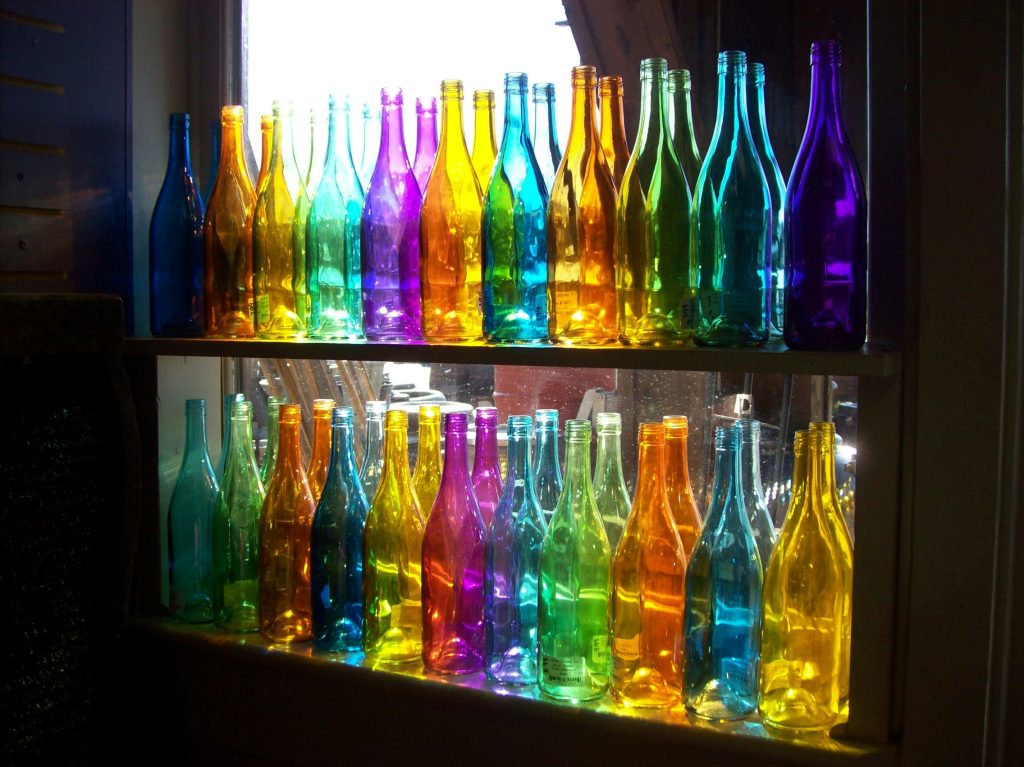
The preparation method is simple and specific. Glass beakers of pure water were covered with coloured theatrical gels in nine colours: red, orange, yellow, green, pink, turquoise, indigo blue, violet, and magenta. Small mirrors surrounded each beaker on four sides, with the beaker sitting on a larger mirror beneath. The idea was to saturate the water with reflected colour. The solution was fixed with high-proof alcohol and sent to Helios Pharmacy to be potentized through the standard homeopathic process of serial dilution and succussion.
The first batch was created in the Lake District on the winter solstice of 1991. What Wauters found was that the hot colours (red, orange, yellow) were strongest in the winter solstice preparations, while the cool colours (green, turquoise, indigo, violet) were strongest in a batch prepared at the summer solstice. The quality of light at different times of year imprinted different qualities into the remedies.
There are ten preparations in total. The nine individual colours, plus Spectrum, which combines all of them at the same potency. Spectrum is, in effect, white light reconstituted. It is used as a recovery remedy after any draining experience. A reset..
How they work in practice
Practitioners describe colour remedies as sitting between flower essences and conventional homeopathic remedies. Gentler than a deep constitutional prescription, but more specific than a flower essence. They are often used alongside classical prescribing, supporting a patient during deeper constitutional work rather than replacing it.
Each colour maps to a specific area of experience:
Red addresses issues of vitality, grounding, and survival. Physically, it relates to circulation, low energy, and weakness in the lower back and legs. Emotionally, it speaks to insecurity, fearfulness, and restlessness.
Orange relates to creativity, pleasure, and emotional flow. Reproductive issues, creative blocks, and emotional stagnation fall within its range.
Yellow connects to confidence, personal power, and the digestive system. Bloating, indigestion, indecision, and low self-esteem are its territory.
Green is the remedy of balance and emotional recovery. It addresses the heart and chest, and the state of depletion that follows turbulence or stress.
Blue relates to communication and expression. Sore throats, hoarseness, and the inability to say what needs to be said.
Indigo connects to intuition and inner knowing. Headaches, migraines, and the sense of being disconnected from one’s own insight.
Violet addresses the nervous system, anxiety, and insomnia. It relates to a need for stillness and connection to something beyond the immediate.
Pink, turquoise, and magenta extend the range beyond the strict seven-colour model, each with distinct indications.
Dosing follows three levels. A 6x potency for physical symptoms, taken several times daily. A 12c for physical and emotional symptoms, once daily. A 30c for a comprehensive single dose across all levels. The effects are observed over a three-day window.
One observation that practitioners return to: colour remedies are particularly useful when emotional or energetic states are difficult to put into words. This makes them valuable for children, for sensitive individuals, and for animals. When language fails, colour still communicates.
A second system. Colour as diagnosis
There is another, quite separate use of colour in homeopathy that is worth knowing about.
Dr Ulrich Welte, a German homeopath practising since 1983, developed a system where a patient’s colour preferences are used to help identify the correct remedy. This is not about giving colour as a remedy. It is about using colour preference as a symptom.
The method originated with Dr Hugbald Muller of Cologne, who noticed in 1985 that patients who responded to Conium (hemlock) not only desired darkness but specifically preferred black. Welte took this observation and studied it systematically across more than 10,000 patients over several decades. Only patients who were healed or showed significant improvement were included in the data.
The finding was striking. Patients cured by the same remedy consistently shared the same colour preference. Over 1,100 remedies have now been mapped to one or two preferred colours. In clinical practice, colour preference proved helpful in identifying the correct remedy in more than half of cases.
Welte describes colour preference as expressing “a person’s prevailing emotional state and the condition of their vital force.” It is a general symptom that requires no interpretation and no leading questions. You simply show the patient 120 colours and ask which ones they are drawn to.
This system works alongside any prescribing method. It does not replace case-taking. It adds a layer of information that can confirm or challenge the direction of a prescription.
Why this matters
Colour remedies take the question we started with and push it further. If different frequencies of light produce different biological effects, and if potentization can capture the energetic signature of a substance or force, then colour becomes available as medicine. Not colour applied to the skin or shone through the eyes, as in traditional chromotherapy, but colour taken internally in a form that interacts with the body’s own systems at a subtle level.
Whether that premise holds is the question each practitioner and patient answers for themselves. What is harder to dismiss is the clinical experience that has accumulated since 1991. Practitioners who use colour remedies describe consistent, reproducible effects. Welte’s 10,000-patient dataset shows systematic patterns between colour preference and remedy response. These are not proof in the conventional sense. But they are observations, made carefully, over decades, by people paying close attention.
Hahnemann built homeopathy on observation before theory. He noticed that cinchona bark produced symptoms in a healthy person that resembled the disease it treated. He did not understand why. He just noticed. Colour remedies are in a similar place. The observations are consistent. The mechanism is not yet understood. But the observations came first, and they keep coming.
Final thoughts
Ambika Wauters trained as an artist before she became a homeopath. That is not a biographical detail. It is a clue. Artists learn to see what colour does before they learn what colour is. They know that blue recedes and red advances, that yellow warms a room and violet stills it, not because anyone told them, but because they watched it happen.
Colour remedies bring that kind of seeing into homeopathic practice. They offer something for the moments when the body is speaking but the patient cannot find the words. When the vital force is disturbed in a way that resists description. When the right remedy is the one that matches not what the patient says, but what they feel when language runs out.
Ten preparations. Nine colours and the light that holds them all. Gentle enough to support a child, specific enough to complement deep constitutional work, and rooted in an observation as old as the temples of Egypt: that light, separated into its parts, acts differently on the human body and spirit.
If you’re new to homeopathy and want to start with the essentials, read our Homeopathy Healthy Holiday Kit
.
Our reading room’s an opportunity to have personal time browsing our shelves full of wisdom.
The Helen Campbell Homeopathy Foundation SCIO is a registered educational charity focused on sharing homeopathy’s fascinating history and wonderful wisdom. We’re here to inform, not prescribe!
Written with AI assistance and checked by our team.